
Custom instructions, writing samples or a Writing Profile: which makes AI write like you
Custom instructions are enough for a few rules. For a voice, they hold only what you can say about your own writing. Here are the four common methods side by side, and a prompt that checks your custom instructions against what you actually wrote.
In about eight minutes, you'll know which of four common methods fits what you want from AI: custom instructions, writing samples, a brand voice tool, or an Idiolect AI Writing Profile. If you only need a few rules, custom instructions are enough, and this page ends with a prompt that checks yours against your own writing.
The short answer
- For a few rules (spelling, length, words you never use), use custom instructions in ChatGPT or Claude.
- For one company's voice across a team, use a brand voice tool such as Jasper Brand Voice.
- For your own voice in different kinds of writing and more than one AI app, use an Idiolect AI Writing Profile.
You can use more than one. The rest of this page explains where each one stops.
Custom instructions: a note you write about yourself
Custom instructions are a note that your AI app reads before it answers. To find them:
ChatGPT
- Open Settings, then Personalization.
- Under Custom instructions, select Edit next to ChatGPT, write your note, then select Save.
Plus, Pro, Business, Enterprise and Education plans allow up to 5,000 characters; the other plans allow 1,500. The note applies to all chats. Inside a project, the project's own instructions apply instead.
Claude
- Select your name in the lower-left corner, then Settings.
- Write your note in your instructions. Anthropic's help page Understanding Claude's personalization features shows where they are in Settings.
The note applies to all your conversations. A project can have its own instructions, which apply only to chats in that project.
Custom instructions are very good at rules you can say in one line:
- "British spelling."
- "No bullet lists unless I ask."
- "Never 'leverage'."
- "In a report, put the recommendation in the first paragraph."
The app follows a rule like that in every chat, and custom instructions come with every ChatGPT plan.
They are weaker at voice, because a note can only hold what you are able to say about your writing. You write "direct, a bit dry, no jargon", and the AI fills in everything else with its own defaults: how long your sentences run, where the point sits in a paragraph, how you open a proposal and how you close an essay. Those unspoken habits are most of what makes writing yours. What your Writing Profile knows about you explains why.
Both apps also have memory, which can save preferences and details from your chats; you can review what it keeps. The custom instructions themselves stay as you wrote them until you edit them.
ChatGPT's Personalization settings may also show a Writing section with a switch labelled Reference my writing style. OpenAI's help pages don't describe it yet, so read what your screen says about it before you turn it on.
Writing samples and skills: real evidence, kept by you
Pasting a few pieces you wrote and saying "write like this" gives the AI evidence instead of a description, which is a real step up. To keep samples beyond one chat, a ChatGPT project keeps chats, files and instructions together, so samples you add to a project are there for every chat in it. In Claude, a skill is a folder of instructions and files that Claude loads when it is relevant, and Anthropic names applying communication patterns from your own writing as one use for it.
The limits:
- You choose the samples and keep them up to date. When a draft misses, you fix it by editing the samples, the project or the skill yourself.
- A few samples of one kind teach one kind of writing. Three reports won't show how you write an essay or a proposal.
- The result is a draft, not a list of habits, so you can't see which of your sentences taught it what.
Brand voice tools: one company, many writers
Jasper's Brand Voice is a good example of this kind of tool. You give it up to eight examples (text, files or web pages). Jasper analyses their tone, style and key characteristics, and gives you a description of the writing plus excerpts you can turn on. Teams use the voice in Jasper's editor, chat and agents, and the Jasper MCP brings the brand's voice and rules into other AI tools.
It is built for marketing teams writing as one brand, with a voice the team agrees on. If that is your job, it fits. If you want your own voice as one person, it is a different shape: it is built around a brand, shared with a workspace unless you make it private, and you change it by editing the voice.
A Writing Profile: built from what you wrote
Idiolect AI builds a Writing Profile from writing you did yourself, then writes and rewrites for you in ChatGPT, Claude, Claude Code, Codex, Cursor and on the web.
It is built from your writing, not your description of it. It finds habits in six parts of your writing, from how you sound to small details of spelling and marks. It also follows how your writing changes with the reader and the form, so a quarterly report, a proposal and an essay can all live in one profile.
Every habit shows its proof: a short quote from your writing, or your own words when it came from something you told it. A habit it has seen too few times is marked Not sure yet. You settle each one with This is right, Fix it or Remove. When you select Fix it and say how you really write, your words are saved as a rule.
It changes when you fix a draft. Tell your AI app what you changed before you sent it, and that edit can update your Writing Profile. A rule you say once, in your own words, applies in every app that writes for you a few minutes later, and a rule always wins over a habit it found. Teach Idiolect AI with your edits and rules shows how.
It keeps voices apart when they should be. Work writing and your own essays can have separate Writing Profiles.
Side by side
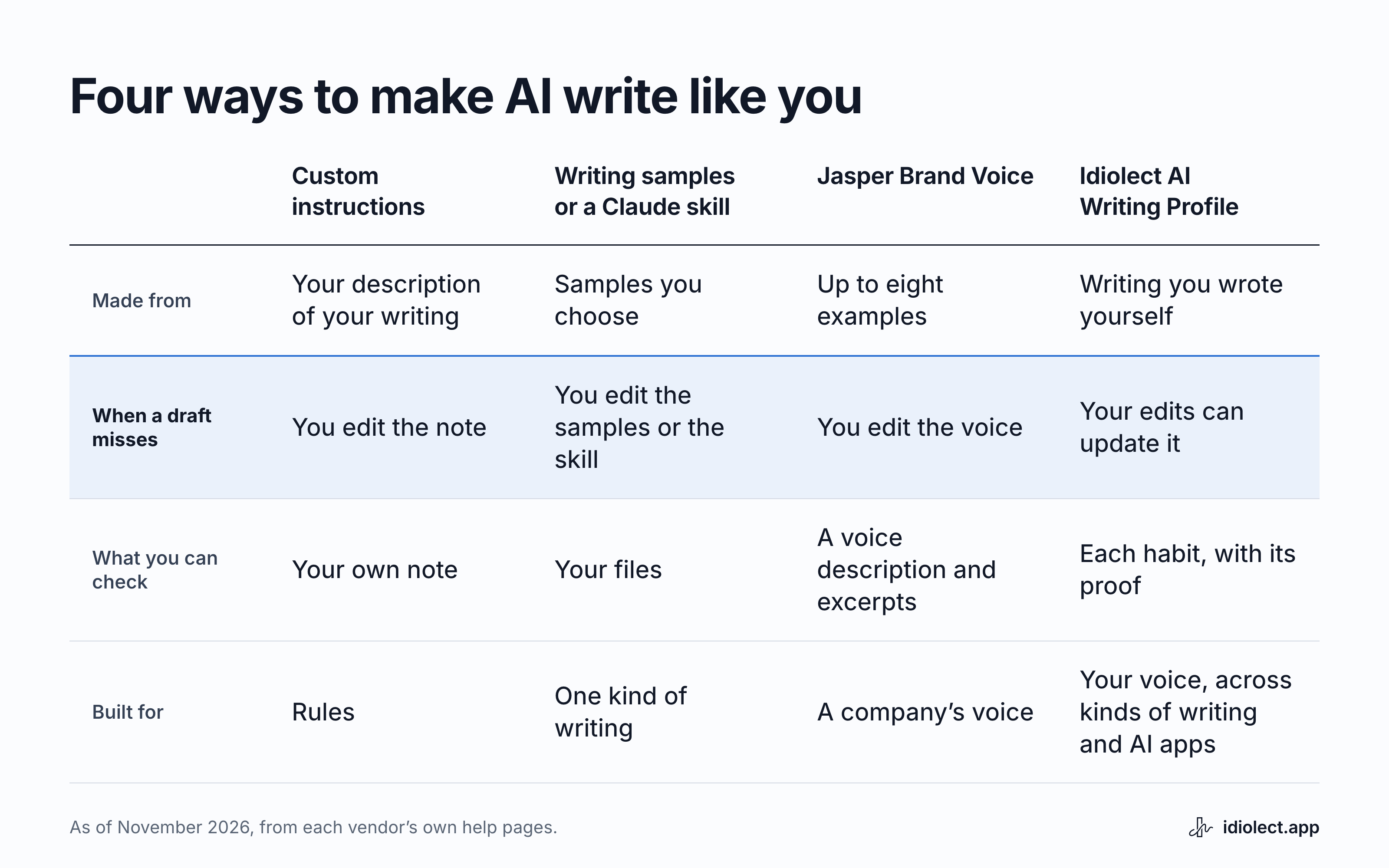
Custom instructions (ChatGPT, Claude)
- Made from: your description of your writing
- When a draft misses: you edit the note
- What you can check: your own note
- Built for: rules
Writing samples or a Claude skill
- Made from: samples you choose
- When a draft misses: you edit the samples or the skill
- What you can check: your files
- Built for: one kind of writing
Jasper Brand Voice
- Made from: up to eight examples
- When a draft misses: you edit the voice
- What you can check: a voice description and excerpts
- Built for: a company's voice
Idiolect AI Writing Profile
- Made from: writing you wrote yourself
- When a draft misses: your edits can update it
- What you can check: each habit, with its proof
- Built for: your voice, across kinds of writing and AI apps
To see what yours would hold, start a Writing Profile. You can start without a card.
Check your custom instructions against your writing
If you stay with custom instructions, test them on evidence. This prompt sets each sentence of your note beside three things you wrote yourself, and marks the ones your writing contradicts. You don't need an Idiolect AI account.
What you need:
- Your current custom instructions, copied from the settings above.
- Three pieces you wrote yourself, for a real reader: for example a report, a proposal and an essay. A few paragraphs each is enough. Leave out anything an AI wrote or helped with.
- Start a new chat in ChatGPT or Claude.
- Copy the prompt below and paste it into the message box.
- Replace the two lines in square brackets. If the app turns your pasted pieces into an attachment, that's fine; leave it and send.
- Send it.
- Find each quote in your own pieces. If a quote isn't there word for word, don't trust the verdict it proves.
Here are my custom instructions about how I write:
[paste your custom instructions]

Check each sentence of my custom instructions (each rule, if they are a list) against the three pieces of my writing at the end of this message. Use only those pieces, not anything else you know about me.

For each sentence, give:
1. The sentence, word for word.
2. A verdict: Matches, Contradicts, or Not enough to tell. If a sentence makes two claims, give a verdict for each.
3. Proof: one short quote from the pieces, under 25 words, copied word for word. Do not change a word, fix spelling or punctuation, or join two parts into one quote. Do not make up a quote. For a claim about length, quote part of a sentence and say how long the whole sentence is. If there is no proof, write "Not enough to tell".
4. If it contradicts the pieces: one sentence that says what I actually do.

Then list up to three habits that the pieces show clearly but my instructions don't mention, each with a quote as proof.

Here are three pieces I wrote myself, with no help from AI:
[paste three pieces, with a blank line between each]
Here is a shortened example of what it returns for writing that is out of copyright: a made-up note checked against three essays by Henry David Thoreau (Walden, Civil Disobedience and Walking).
2. “Use short sentences.”

Contradicts. Proof: “I wanted to live deep and suck out all the marrow of life” (the whole sentence is 99 words).
What you actually do: You write long, multi-clause sentences as your default and use the occasional very short one for punch.

3. “Never use semicolons.”

Contradicts. Proof: “Government is at best but an expedient; but most governments are usually, and all governments are sometimes, inexpedient.”
What you actually do: You use semicolons often, in all three pieces, to join contrasting clauses.
The note after the check: "Write long, multi-clause sentences, with the occasional very short one for punch. Use semicolons to join contrasting clauses."
Keep the claims marked Matches. Rewrite each one marked Contradicts to say what you actually do. Add the habits it found, if they are true. A claim marked Not enough to tell is a rule, not a description; keep it if it is what you want.
Why it works: each sentence of your note is a claim, and a quote is the evidence for or against it, which is why you check every quote yourself. To describe your writing from nothing instead, use How do I write?
The idea underneath
In 1968 the linguist Peter Trudgill tested how well people in Norwich, in the east of England, knew their own speech. He had already recorded them talking. Then he read words such as tune aloud in two or more ways, for example the standard "tyoon" and the local "toon", and asked which was closer to the way each person normally said it. Then he set their answers beside the recordings.
Many answers were wrong, and they were wrong in a pattern. On tune, every person who claimed the standard form without using it was a woman; no man did. On the vowel in road and nose, more than half the men claimed the local sound when they used the standard one. A few years earlier in New York, William Labov had found the more familiar pull: most people who dropped the r in words like car said they kept it. In both cities, people heard themselves as the speaker they meant to be. The women aimed at the standard; many men, Trudgill argued when he published the study in 1972, privately prized the local speech, and their complaints about their own "bad speech" were for public consumption only.
A description of your own writing is the same kind of answer. It is honest, and it leans towards who you want to be: more direct, more concise, less fond of a certain word than you are. That is why the check above doesn't ask you to describe yourself again. It does what Trudgill did, and sets what you say beside what you did.
Next: Your first draft in your own voice, in five minutes. Or start a Writing Profile from writing you already have.