In about five minutes you will have your first draft from Idiolect AI. You need Idiolect AI connected to ChatGPT, Claude or another AI app. If you don't have an AI app, you can do it on idiolect.app instead: Idiolect AI on the web shows each step.
Connecting is the easy part. What most people miss is the next step: asking for something. Idiolect AI does nothing until your AI app has a piece of writing to do for you.
In ChatGPT or Claude
- Start a new chat. Some apps only see a new connector in a fresh chat.
- Check that your AI app will use Idiolect AI in this chat. In ChatGPT, name Idiolect AI in your first request, as request 1 below does. In Claude, select + in the message box, then Connectors, and check that Idiolect AI is switched on.
- Copy one of the three first requests below into the chat.
- Change the part in brackets, then send it.
- Read what comes back. Idiolect AI returns the writing to you. It never sends or posts anything.
If Idiolect AI is not in the list, or the app asks you to sign in again, see Reconnecting and other connection fixes.
Three first requests to copy
1. Rewrite something you already wrote. This is the best first test, because you know exactly how you would say it.
Use Idiolect AI to rewrite this sentence: [a sentence that you wrote]2. Ask for one small, real piece of writing. Pick something you need today. A note to your team, a reply to a friend, a short update.
Write a short note to my team: this week's review has moved from Wednesday to Thursday at 4pm.3. Give it your writing first. Paste four things you wrote yourself, such as emails, messages or posts. Use your own words only, not AI text or something someone else wrote.
Set up my Writing Profile in Idiolect AI. I wrote these myself:

[paste 4 things you wrote, with a blank line between each]
You don't have to name Idiolect AI after the first time. Your AI app is asked to use Idiolect AI whenever it writes for you.
The first time you ask
If you don't have a Writing Profile yet, Idiolect AI may ask about your writing before it writes. Your AI app may show you the choices, or pick the one that fits what you already said. The choices are:
- Answer a few questions about how you write. Your answers start your Writing Profile.
- Paste some things you wrote. Your own writing teaches it the most.
- Use a ready-made style for this one piece: Plainspoken, Conversational or Analytical.
- Write it now. Say "Just write it". Idiolect AI writes with what it has, and learns as you use it.
Pick the one that suits you. Any of them gets you a first draft.
Before and after
Here is request 2 above, written twice. Both drafts are our illustrations. Neither is output from Idiolect AI or from anyone's Writing Profile.
A plain AI draft, written the way a general AI assistant often answers:
Hi team! 👋 Quick heads-up: this week's review has been rescheduled from Wednesday to Thursday at 4:00 PM. Please update your calendars accordingly. If the new time doesn't work for you, just let me know and we'll figure something out. Thanks so much for your flexibility! 🙏A draft in one person's voice, for someone who opens with "Hi all", gives the news in one line and doesn't thank people in advance:
Hi all,
The review moves to Thursday at 4pm this week, not Wednesday.
The second one is not better because it is shorter. It is closer to how that person writes. The first one offers to "figure something out" that nobody asked about, and thanks people for a flexibility they haven't shown yet. Your own draft will look different, because your Writing Profile comes from how you write. To see the difference for yourself, send request 2 above, then ask your AI app for the same note without Idiolect AI.
Why it works
Idiolect AI keeps a Writing Profile of how you write: how you open and close, how long your sentences run, the words you use and the ones you avoid. When your AI app asks it for a piece of writing, it writes that piece with your habits. The writing you give it, the edits you make and the rules you tell it all add to the profile, so the drafts get closer to you over time.
That is also why the first request matters more than the setup. The connection is only a road. The first request is the first thing that travels on it.
The idea underneath
Look at the two drafts again. The plain one explains everything: the date, the time, what to do about the calendar, what to do if the time is bad. The second one says only the news.
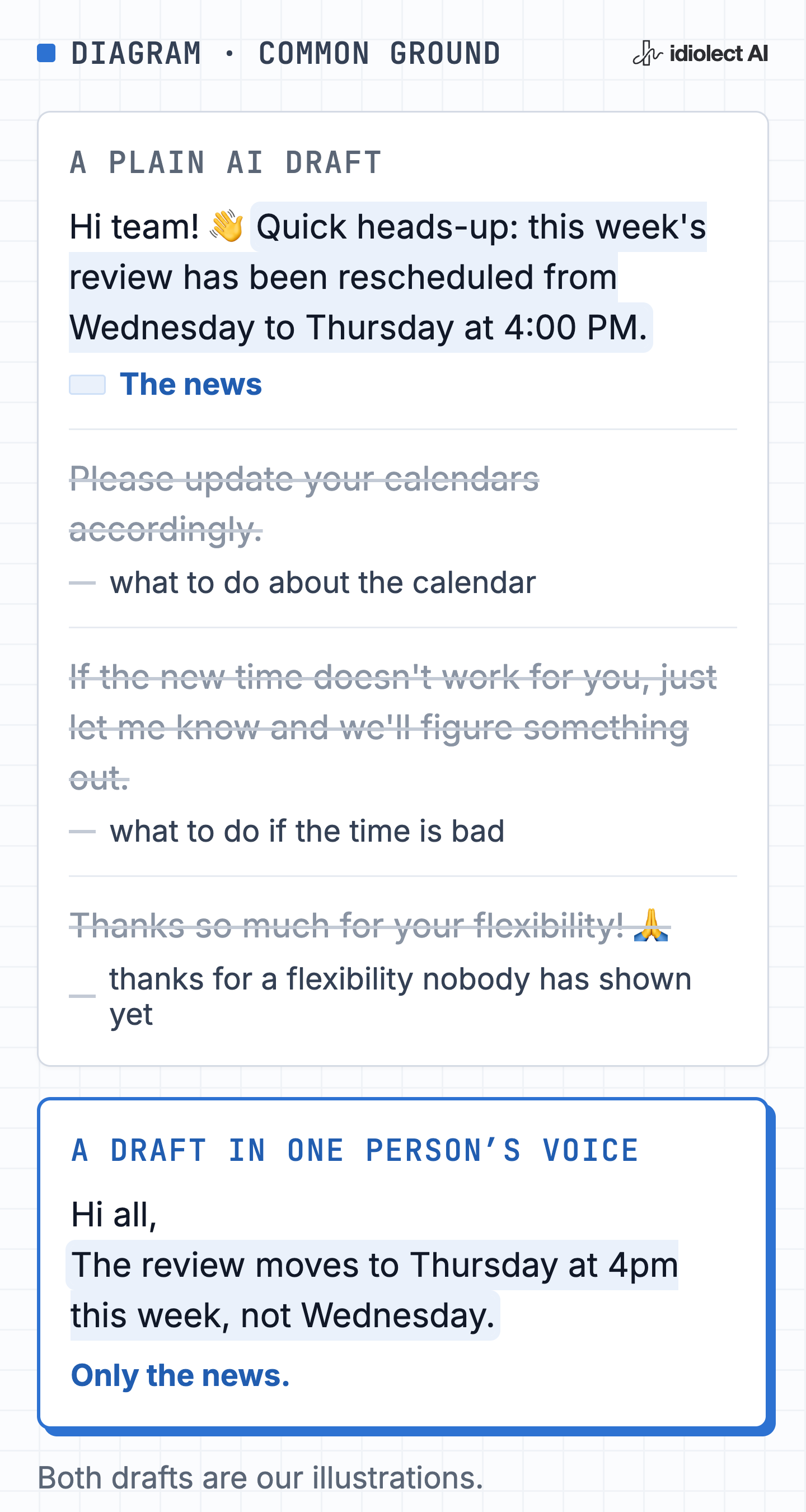
People who know each other leave things out. The psycholinguists Herbert Clark and Susan Brennan called what they share common ground: what both sides know, and know that the other knows. A team that meets every week doesn't need to be told to update a calendar. When you write to people you know, you lean on that common ground, and your message gets short.
General AI has no common ground with your reader, so it fills every gap. That is a large part of why AI writing feels like it came from a stranger. A draft in your own voice keeps the gaps that you would keep.
Next
Using Claude? Read Idiolect AI in Claude for the steps on the web, in the desktop app and in Cowork, and what to do when Claude doesn't use it.