Paste four to six things you wrote yourself into Claude or another AI chat, with this prompt. In about a minute it tells you how you write, under seven headings, with a short quote of yours as proof for each. You don't need an Idiolect AI account.
What you need
Four to six pieces of writing that you wrote yourself. Emails, messages, posts or notes all work. A few lines each is enough.
- Use: things you wrote to send to a real person.
- Leave out: anything an AI wrote, anything someone else wrote, and forwarded or quoted text.
- Take out: private details about other people, such as names, addresses or phone numbers, if you'd rather not paste them.
The prompt
Here are some things I wrote myself:

[paste four to six pieces here, with a blank line between each]

Tell me how I write, using only the pieces above. Describe how I write to other people, not what the pieces are about.

Answer under these seven headings:
1. Who I usually write to
2. How formal or casual I am
3. How I greet people
4. How I sign off, and with what name
5. My habits: sentence length, how fast I get to the point, punctuation, lists, emoji, how I ask for things and how I give bad news
6. Words and phrases I use a lot
7. Words and phrases I never use

Under each heading, give one short quote of mine as proof: a whole sentence or a complete phrase, under 25 words, copied word for word from the pieces above. Do not change a word, fix spelling or punctuation, or join two parts into one quote. Do not make up a quote. If the pieces don't show it, write "not enough to tell". For heading 7, name a word only if the pieces clearly show I avoid it, for example where I always say something another way.
Steps
- Start a new chat in Claude or another AI chat.
- Copy the prompt above and paste it into the message box.
- Replace the line in square brackets with your four to six pieces.
- Send it.
- Read each quote and find it in your own writing. If a quote isn't there word for word, don't trust the point it proves.
Optional: add your past chats
If your AI app can see your past chats, you can add this line under your pieces:
Also look at our past conversations for things I wrote myself.Some apps only keep summaries of past chats. If it can't show your exact words, it should say so. Paste your writing instead.
What it looks like
Here is what the prompt returns for writing that is out of copyright: four letters by Jane Austen to her sister Cassandra, from 1796 to 1798, and four letters by Abraham Lincoln, from 1843 to 1862. Every quote in these answers is in the letters, word for word.
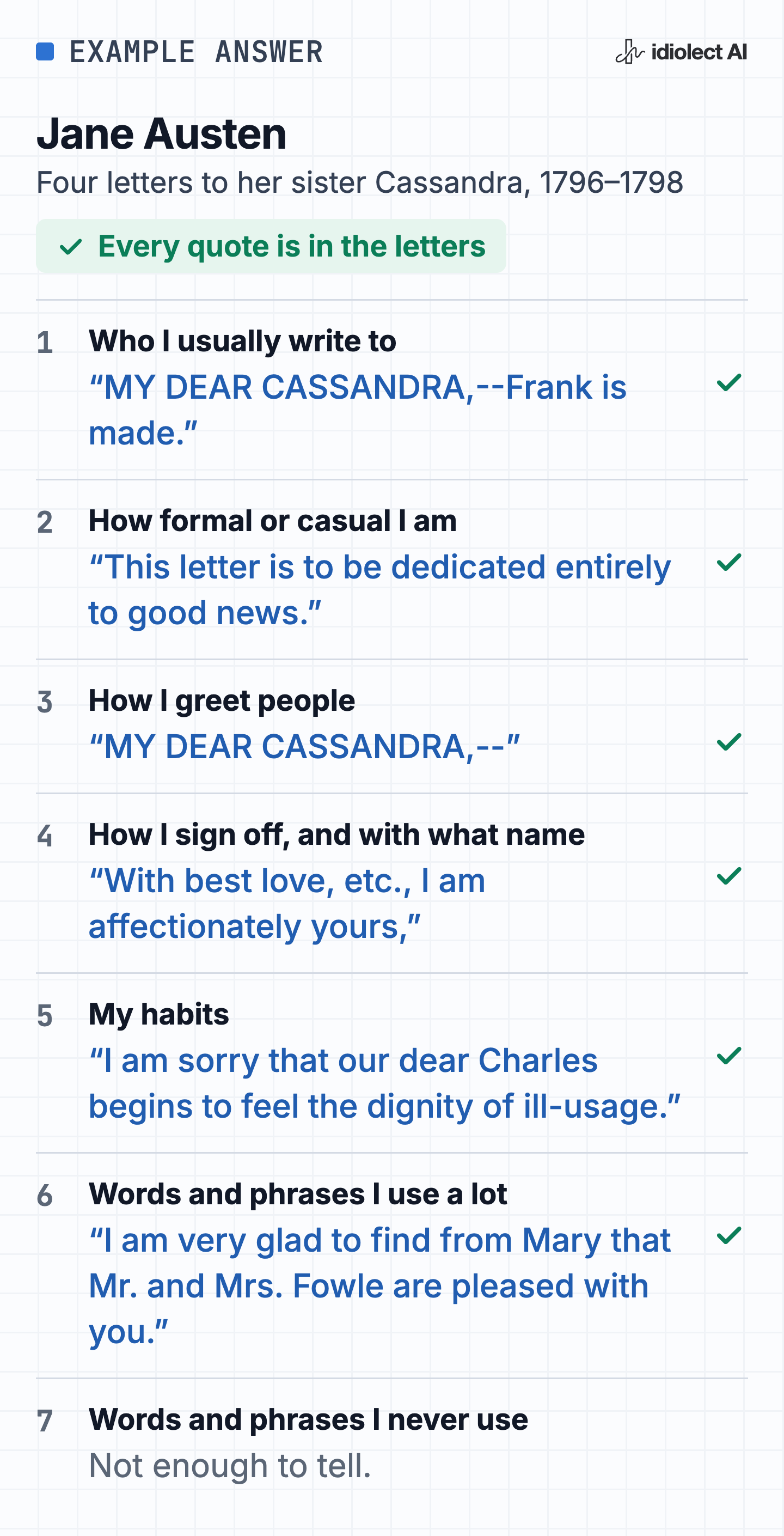
Some of the answer for Austen:
How I greet people. Almost always "MY DEAR CASSANDRA," followed straight away by a double dash and the first sentence. The first letter shown has no greeting.
How formal or casual I am. Polite and carefully built, but playful and teasing underneath. You joke with your sister while keeping a formal sentence shape. "This letter is to be dedicated entirely to good news."
And for Lincoln:
My habits, bad news. You state the refusal plainly. You often follow it with something useful, such as a firm offer, a reason or some advice. "I regret the necessity of saying I have no daughter."
For both writers, the answer under "Words and phrases I never use" was "Not enough to tell". That is the right answer. Four letters can show what someone says. They rarely show what someone never says.
What this prompt is, and isn't
It is a description that you check yourself. It isn't a test, and it can be wrong. It only sees the pieces you give it, so four work emails describe how you write at work, not how you write to your friends. If you want both, run it twice.
Why it works
The seven headings are the things a person who reads a lot of your writing would notice: who you write to, how you open, how you close, and the small habits in between. They are also the things that most AI drafts get wrong.
The quotes do the most work. Each point must point back to something you actually wrote, and you can check it. A point with no quote under it is only an opinion.
The idea underneath
In 1948 a psychologist, Bertram Forer, gave 39 of his students a personality test. Then he gave each of them a "personal" description of their results, and asked them to rate how well it fit, from 0 to 5. On average they rated it above 4. Every student had the same description. Forer had put it together from an astrology book.
This is now called the Forer effect, or the Barnum effect. Vague, flattering descriptions feel personal, because each of us finds ourselves in them. "You can be warm, but you are direct when it matters" fits almost everyone.
A description of your writing has the same risk. "You are clear and friendly" sounds right, and tells you nothing. The cure is evidence. A quote in your own words can't fit everyone, because only you wrote it. That is why the prompt asks for a quote under every heading, and "not enough to tell" when there isn't one.
Keep it in Idiolect AI
Want AI to write like this every time? Idiolect AI turns the same pieces into a Writing Profile that ChatGPT, Claude and your other AI apps use whenever they write for you. It keeps learning as you write.
- In ChatGPT or Claude: connect Idiolect AI at idiolect.app/connect. Then start a new chat, paste your pieces, and say "Set up my Writing Profile in Idiolect AI from these. I wrote them myself."
- On the web: go to idiolect.app/start, select Add your writing, and paste one piece in each box. If the page asks for more writing, add another piece.
- Let your AI collect it for you: Let your AI build your Writing Profile has ChatGPT or Claude find your own writing in your past chats, connected apps and files, check who wrote each piece, and send only what you approve.
- Agree with a line in your answer? Tell Idiolect AI in your own words, for example "I never sign off with 'Best'", and it becomes a rule.
Next
Ready to try it in a chat? Your first draft in your own voice, in five minutes shows the first sentence to type.