No old emails to paste? You can still get good writing today. Idiolect AI has three ready-made styles that work with no samples at all. Choosing one takes a sentence. Starting your own Writing Profile without samples takes about five more minutes.
The three styles
These are the product's own descriptions:
- Plainspoken: Everyday words, complete sentences and the specifics first.
- Conversational: Talks to the reader directly, the way you would say it.
- Analytical: Works the reasoning through in ordinary words, one idea at a time.
The same message, three ways
To show the difference, we wrote one short message in each style, following the rules that each style gives the writer. These are our illustrations, not output from the product. All three use only these facts: the office is closed this Friday while the heating is replaced, everyone works from home that day, Monday's team lunch is still on at 12:30, and anyone who can't work from home says so by Wednesday.
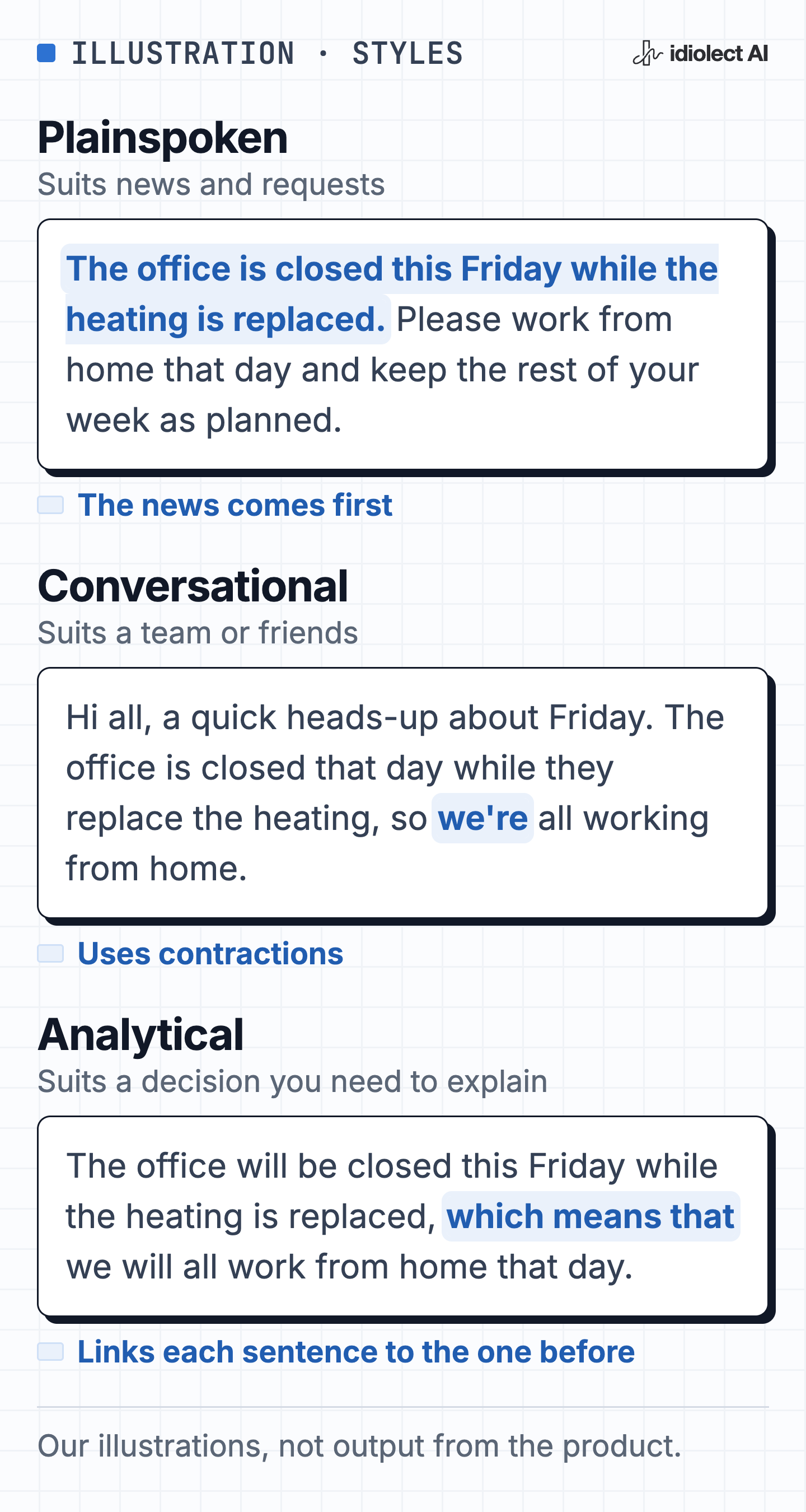
Plainspoken. The news comes first. Sentences are one point each, and there are no warm-up words.
The office is closed this Friday while the heating is replaced. Please work from home that day and keep the rest of your week as planned.

Monday's team lunch is still on, at 12:30. If you can't work from home on Friday, tell me by Wednesday and I'll find you a desk nearby.
Conversational. It talks to "you" as "I", uses contractions, says what the writer feels, and asks a real question.
Hi all, a quick heads-up about Friday. The office is closed that day while they replace the heating, so we're all working from home.

Nothing else changes, and Monday's team lunch is still on at 12:30. I'd love to see everyone there!

Can't work from home on Friday? Tell me by Wednesday and I'll find you a desk nearby.
Analytical. It gives the reasons, links each sentence to the one before, and answers the obvious objection.
The office will be closed this Friday while the heating is replaced, which means that we will all work from home that day. I expect this to change little else, because the closure covers one day only, and the rest of the week, including Monday's team lunch at 12:30, goes ahead as planned. That is why I am not moving any of our other plans.

Working from home is not equally easy for everyone, though, and a day away from the office can still be a real problem if, for example, you have no quiet space at home. If that applies to you, tell me by Wednesday, and I will find you a desk nearby, which gives us two days to arrange it before Friday.
Plainspoken suits news and requests. Conversational suits a team or friends. Analytical suits a decision you need to explain.
Use a style in ChatGPT or Claude
You can choose a style while you have no Writing Profile.
- Ask your AI app for a piece of writing, as usual.
- Idiolect AI asks about your writing first. Your AI app may show you the choices, or pick one for you.
- Say which style you want, for example:
Use the Plainspoken style for this one.To use one style for all your new writing, say so:
Use the Conversational style for all my new writing.To change a draft you already have:
Redo that in the Analytical style.To stop using a style for all new writing:
Stop using the Conversational style as my default.Know this before you choose
A ready-made style is not your voice. When Idiolect AI writes in one, it writes in that style, not in yours, and your Writing Profile learns nothing from it.
Once you have a Writing Profile, your profile writes instead. New writing uses your profile ahead of any style you chose as a default.
Start your own Writing Profile with no samples
You don't need a folder of old writing. You need a few minutes of new writing.
On the web: go to idiolect.app/start, select Add your writing, then Answer 4 questions instead. Idiolect AI on the web shows each step and the four questions.
In ChatGPT or Claude
When Idiolect AI asks about your writing, choose to answer the questions. Your answers start your Writing Profile, and it grows as you write. Or say "Just write it". Idiolect AI writes now with what it has, and asks again later only when it needs to.
Why it works
Each style is a set of rules for the writer: how long the sentences run, whether to use "I" and "you", where the news goes, how to link one idea to the next. They are rules that good writers in that style follow, so a style gives you clean writing on day one.
Your answers to the four questions work differently. They are real writing, by you, for a real kind of reader. So they carry your habits: your greeting, your sign-off, how quickly you get to the point. A style can only lend you someone else's habits. Four short answers start teaching Idiolect AI yours.
The idea underneath
Linguists use two words that explain the difference.
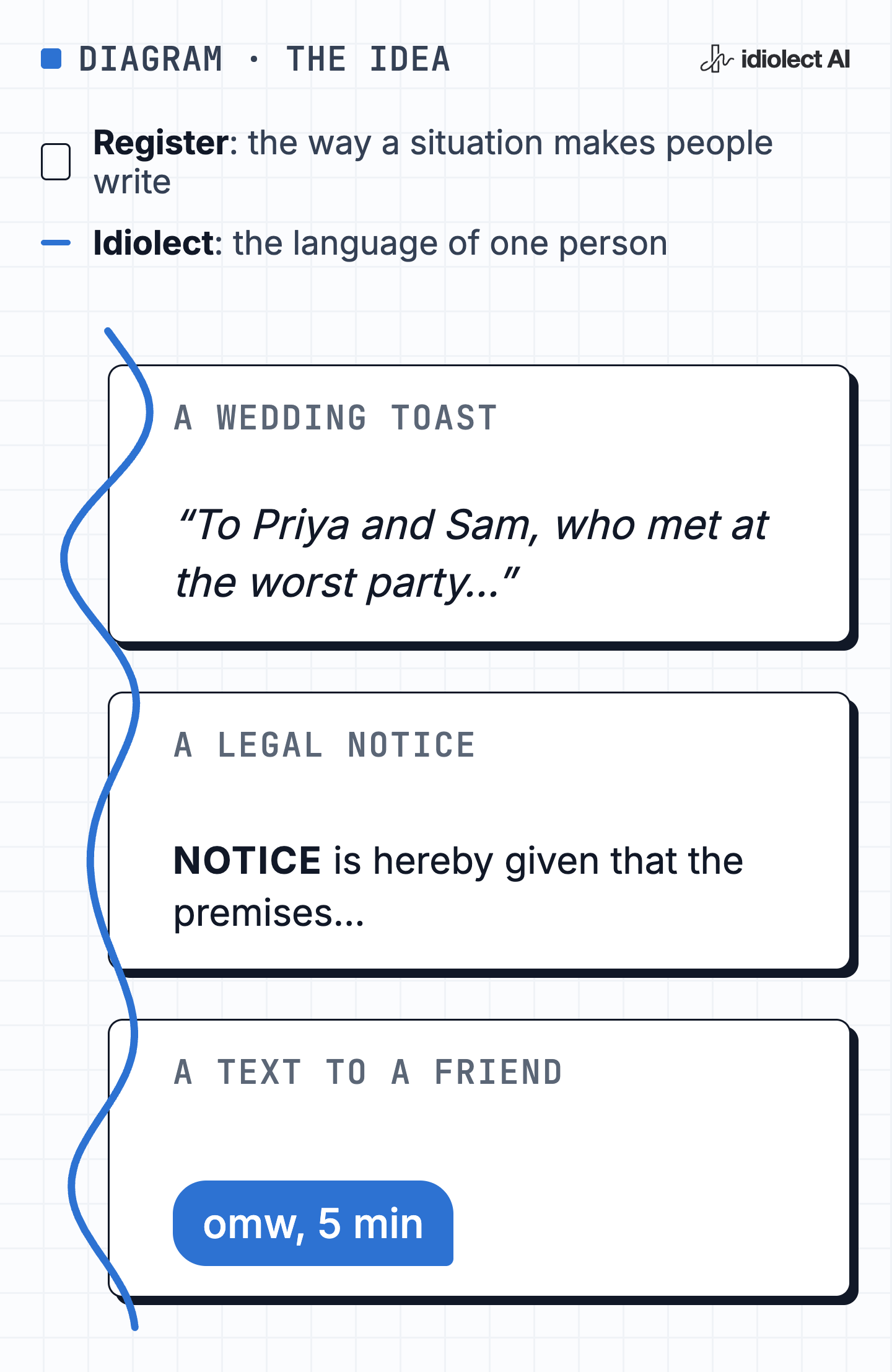
A register is the way a situation makes people write. A wedding toast, a legal notice and a text to a friend each have their own register, and anyone who writes one tends to follow it. The three ready-made styles are registers. Anyone can use them, and they sound the same whoever uses them.
An idiolect is the language of one person: the words, rhythms and small habits that are yours alone, in every register you write in. You write a toast and a complaint differently, but both still sound like you. That second word is where Idiolect AI gets its name.
A ready-made style gets the register right. Only your own writing can teach it your idiolect.
Next
Once you've answered the questions, see What your Writing Profile knows about you, and how it learns.