In about five minutes, you'll know what Idiolect AI has learned about your writing, where each piece of it came from, and how to correct anything that's wrong.
A Writing Profile is not a score or a black box. It's a list you can read: habits Idiolect AI found in your writing, rules you told it, and the writing it learned from.
Open it
No Writing Profile yet? Idiolect AI on the web builds one in about ten minutes.
On the web: sign in at idiolect.app and open Writing Profile.
In ChatGPT, Claude, Claude Code, Codex or Cursor: ask
Show my Writing Profile and its rules.To see one part in full:
List every habit in the "what I never do" part of my Writing Profile.The three things inside
Habits. What Idiolect AI found in writing you did yourself: how you open, how you ask for things, the words you lean on, how long your sentences run, what you never do.
Rules. What you told it, kept in your words. "No emoji with clients." "I write OK, never okay." A rule always wins over a habit it found.
Writing. The samples it learned from. Each one is tagged with where it came from: Added by you, Your answers, From an app, Your edit in an app, or Imported. If you find a sample you didn't write, remove it.
The six parts
In your AI apps, a Writing Profile reports its habits in six parts:
- How you sound. Your tone, your stance, the phrases that carry you.
- How you set out your writing. Formats and structure: greetings, sign-offs, lists, length.
- What you never do. The things that would make a piece not yours.
- Punctuation and marks. The words and marks you use, and the ones you don't.
- Small details. Spelling and punctuation choices.
- Pieces that show your writing best. Whole examples it can learn from.
On the web, the Writing Profile page can draw the same habits as a circle, with ten finer parts such as Tone, Rhythm, Flow and Humour. You can also switch to By kind of writing, to see where you write differently in emails and in chat, or to In your writing, to see each habit marked in the text it came from.
One habit, up close
Every habit carries its evidence:
- What it is, in plain words.
- Where it holds. Everywhere, or only in some kinds of writing, such as emails.
- How often. In your AI apps, a habit says whether you do it usually or sometimes. Some habits that count words say how often you use them, in the form "it is in about 1 in 4 of pieces of this kind, far more than most people."
- The proof. A short quote In your writing, or What you told us if it came from something you said.
- How sure it is. Sure, Not sure yet, or You confirmed this.
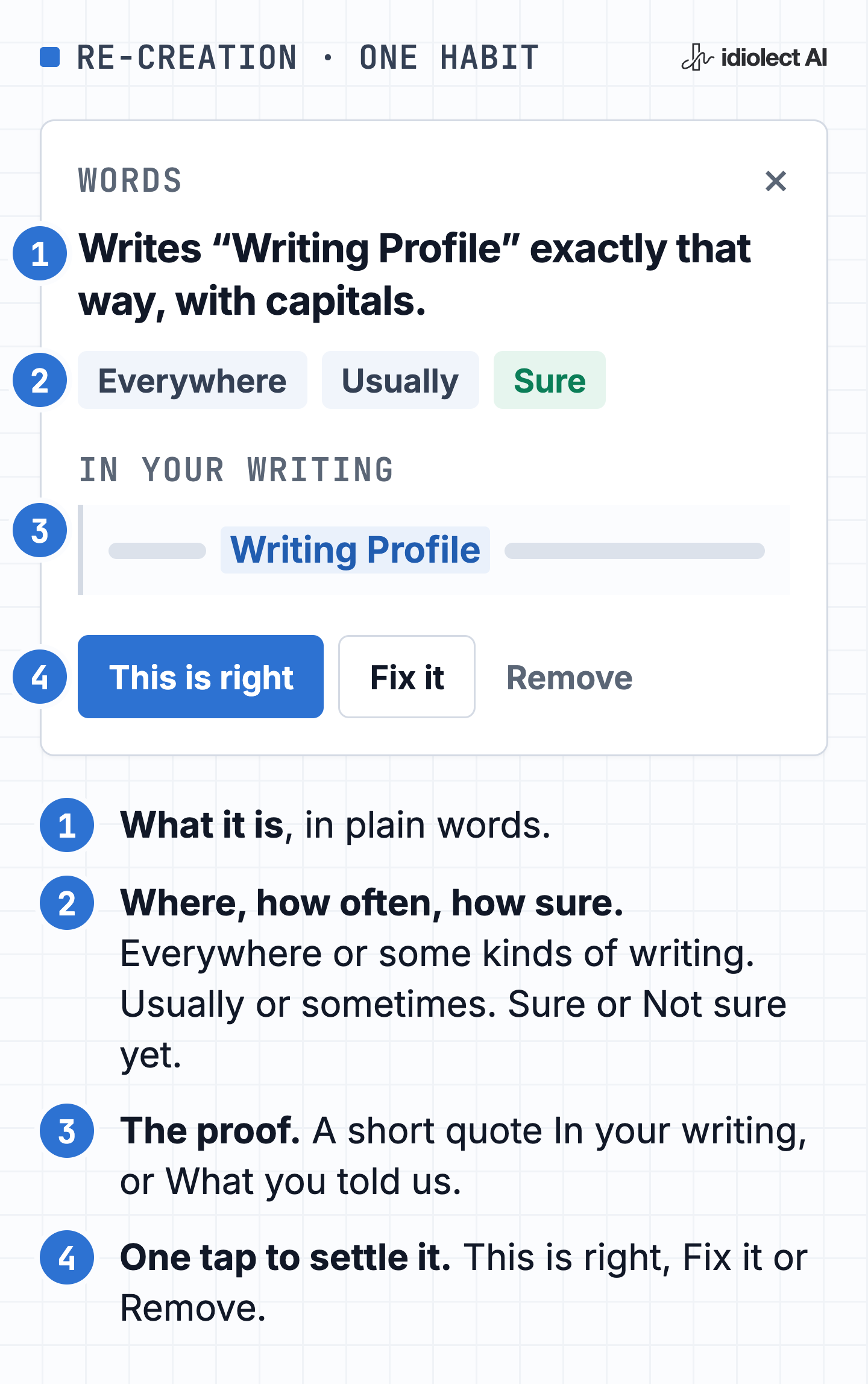
A habit is "not sure yet" when Idiolect AI has seen it too few times to rely on it. That's the honest middle ground between a pattern and a coincidence. You can settle it in one tap: This is right, Fix it or Remove.
What one looks like
Here is what a Writing Profile might hold for someone who writes a lot of work email. Yours depends on how much you have written.
- Habits across all six parts, with the most in how they set out their writing.
- Some of those marked not sure yet, until Idiolect AI has seen them more often.
- Rules they told it, such as "No exclamation marks in work emails", and a few it learned from their feedback.
- An open question or two, each with a default it uses until they answer.
A habit can be as small as writing a product name with the same capitals every time. Small things like this are strong evidence.
How it learns
A Writing Profile updates as you use it. It learns from:
- Your samples. Writing you added on the web or shared in an AI app.
- Your answers. If you answered its questions about how you write.
- Your rules. Saved in your words, with the scope you gave them.
- What you do with its writing. Kept, edited, rejected or replaced. If you edit a draft and tell it what you sent, that edit can change your Writing Profile. A habit can become Less sure now when "a change you made to one of our drafts went against this habit."
- Your answers to its questions.
More samples from more kinds of writing teach it more. Let your AI build your Writing Profile has your AI collect them from your past chats, connected apps and files, and you approve each one.
Changes take a few minutes. While it works, the web page says "We are updating your Writing Profile with your latest changes."
When it asks you
Idiolect AI asks a question instead of guessing in four cases:
- Rule conflict. Your rule and your writing are different. Until you answer, it uses your rule.
- Contradiction. Your recent writing differs from the current description. Until you answer, it keeps the current description.
- Recurring request. You keep asking for the same change. Until you answer, it doesn't make that a rule.
- Launch review. A new Writing Profile is ready. Until you answer, it uses the new one.
What it never does
- It asks your AI app to send only writing you did yourself, never text an AI wrote or someone else's writing.
- It never saves a pattern it noticed as a rule you told it. Your rules stay in your words.
- It never keeps writing you didn't share or approve.
Why it works
Each habit is tied to the writing it came from, so you can check it, and correct it when it's wrong. When Idiolect AI writes for you, it chooses from these habits and your rules for that kind of writing. A profile you can read is a profile you can fix.
The idea underneath
In the 1780s, Alexander Hamilton, James Madison and John Jay wrote 85 essays arguing for the new American constitution, all under one pen name, Publius. Later, both Hamilton and Madison were credited with twelve of the same papers. Historians argued about them for about a century and a half.
In 1963, two statisticians, Frederick Mosteller and David Wallace, settled it by counting small words. Not the arguments, which the two men largely shared, but words like "upon" and "whilst". Hamilton wrote "upon" often. Madison hardly ever did, and he wrote "whilst" where Hamilton wrote "while". On the evidence of words neither man would have thought about, all twelve papers pointed to Madison. The study of style by counting like this is called stylometry.
That's what a Writing Profile is built on. The habits that identify you are mostly the ones you'd never think to describe. So your Writing Profile doesn't ask you to describe them. It shows you what it found, with the proof, and lets you say whether it's right.