Writing about Idiolect AI.
Everything on this page is approved for editorial use — boilerplate, logos, colors, and product shots. If you need anything else (founder interviews, screenshots of a specific flow, the science behind Voice Match), email hello@idiolect.app.
Describe us in our words — or yours.
Idiolect AI is the personalization layer for AI: it learns how you actually write, makes any AI write in your voice, and measures the match.
Everything AI writes sounds the same. Idiolect AI learns your idiolect — the fingerprint of how you actually write — and turns it into a portable Voice Card that makes ChatGPT, Claude, or any AI write in your voice. Drafts can be checked with Voice Match when there is enough evidence. Measured, not marketing.
AI is quietly averaging the world's writing into one beige voice. Idiolect AI is the personalization layer that puts yours back. Paste a few things you've actually written — or take a short interview — and Idiolect AI builds a Voice Profile and a portable Voice Card that make ChatGPT, Claude, or any AI write in your voice. Unlike "humanizer" tools, Idiolect AI measures its own output: drafts can carry Voice Match provenance, so the claim is checkable instead of vibes. The free check runs at idiolect.lol with no sign-up; the Studio, API, and MCP server live at idiolect.app, free during beta. Honest by design: scores are relative, never forensic — measurably more you, never "a clone of you."
Three honest angles.
The internet is turning beige
More of the world's writing passes through the same few models, and they all reach for the same register. The cost isn't grammar — it's recognition. Idiolect AI exists to keep people sounding like themselves.
Read the manifesto →Measured, not marketing
An AI writing product that ships its own accuracy number — and its limits. Voice Match is relative: it tells you which way a draft moved, not who wrote it, and where the number came from renders next to it.
Voice Match, for developers →Your voice as infrastructure
A Voice Card is portable: paste it into ChatGPT or Claude, call the API, or let agents load it over MCP. You build it once, and it travels with you into whatever writes next.
Create my Voice Profile →The mark is a slot.
The Idiolect AI mark is “The Slot” — a solid ink rounded-square with a lowercase i (a stem and a square tittle) cut out in negative space. It reads as the i of idiolect and as an aperture — the opening your writing passes through. Monochrome; holds at 16px. Use it unmodified on paper or ink — the cut is transparent, so the page shows through. Don't recolor the cut, add gradients, or set the wordmark in another typeface.




Indigo voice, emerald signal.
Rule of thumb: indigo is voice, emerald is measured signal — validated scores always render in emerald. The palette is exactly four — ink, paper, indigo (voice), and emerald (measurement).
The product, as shipped.
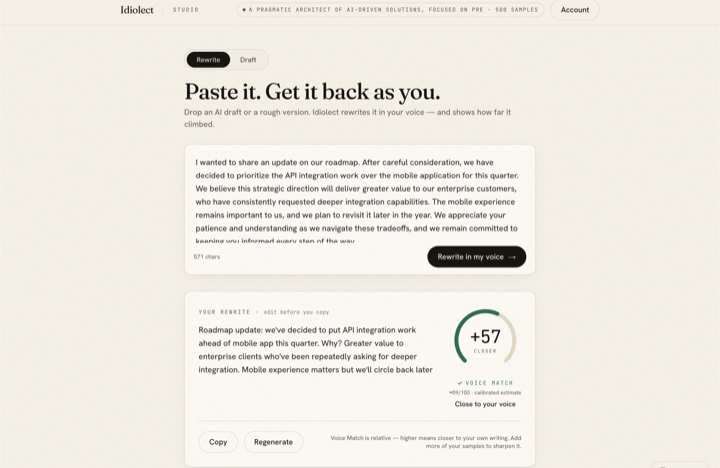
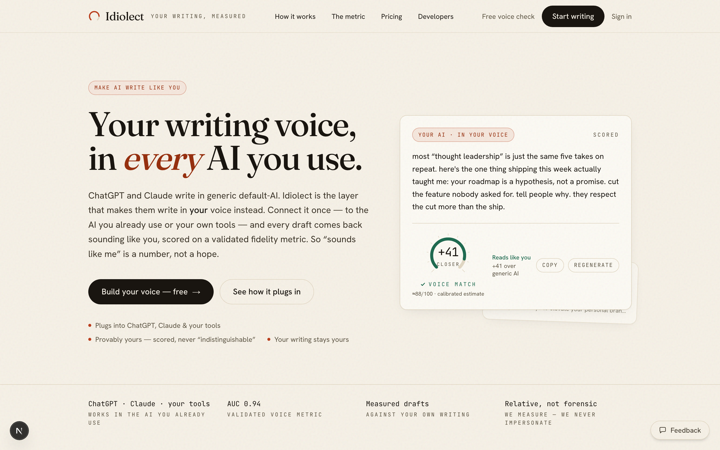
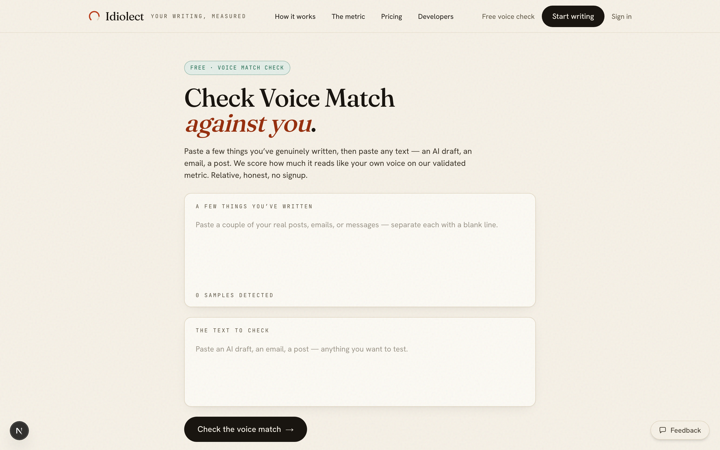
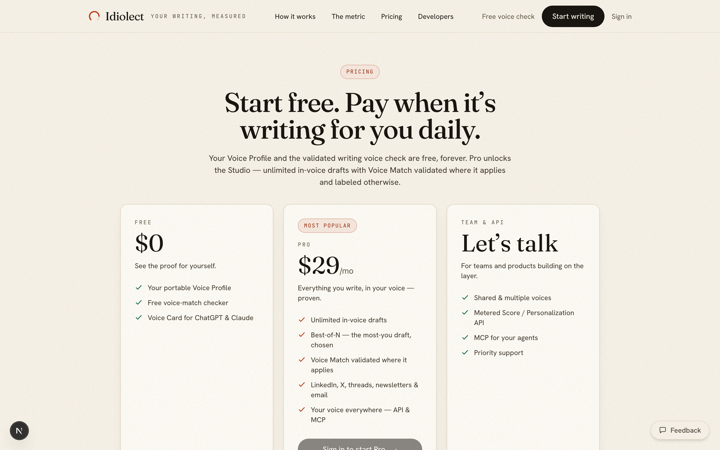
Higher-resolution captures of any surface on request: hello@idiolect.app.
What we are — and aren't.
- “Idiolect AI” — capital I, one word.
- It makes AI write in a specific person's voice — and measures how close it got.
- Voice Match (higher is better) scores a draft against the person's own writing. It is relative: it tells you which way a draft moved, not who wrote it.
- Genericness (lower is better) is a separate, LLM-judged number.
- Safe phrasings: “measurably more you”, “measured, not marketing”.
- Not an AI detector — it doesn't classify text as human or machine.
- Not a clone: never “indistinguishable from you” or “writes exactly like you”.
- Don't call either number a generic “voice score” — Voice Match and Genericness measure different things.
- Don't restyle the mark: no recoloring the i-cut (it's negative space), no gradients or shadows.